
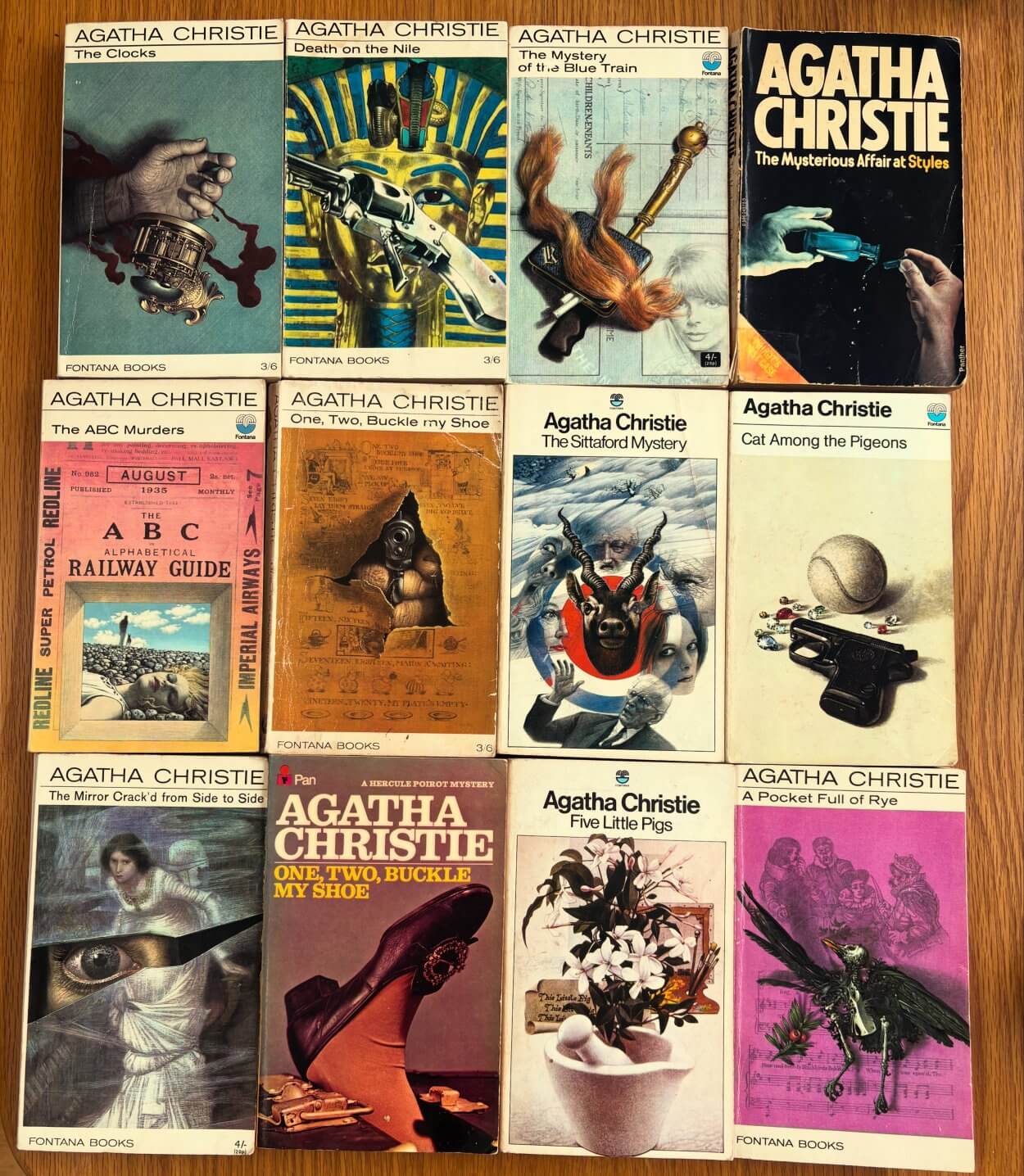
New to the wonderful world of Agatha Christie? Not sure where to start? Read on for some recommendations from across her canon, from creepy Marple novels and classic Poirot mystery puzzles, to some much-loved standalone novels: here are some excellent Christie books to get you going…
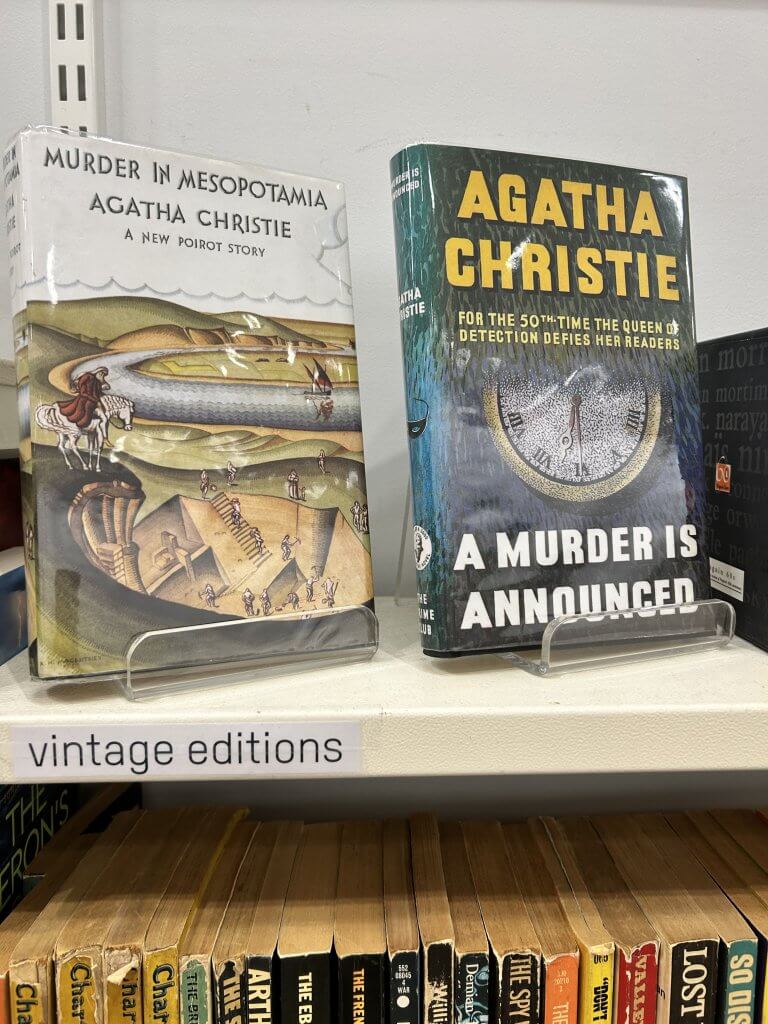
A Murder is Announced – Miss Marple (1950)
Agatha Christie’s 50th book, published in 1950, A Murder is Announced, is often praised as one of Agatha Christie’s best Miss Marple novels.
Coming out at the dawn of the 1950s, this is when Agatha Christie was the undisputed Queen of Crime. This book truly revels in the satisfying English country village murder plot that made her so famous.
Set in the picturesque English country village of Chipping Cleghorn, a murder is literally announced in the local newspaper. A specific time and a location for the murder are given, and thinking it may be a hoax, curious villagers arrive to the appointed spot at the appointed time. Then the lights go out…
The ensuing murder and investigation are conducted by Miss Marple and the local police. Though some of the details and characters of the case seem a little far-fetched, the actual murder set-up is ingenious..
How does the murderer do it? Miss Marple senses something is off, but can she crack the mystery before the audacious murderer strikes again? A real murder mystery original where you have to pay close attention to all the minutiae…
The Pale Horse – Ariadne Oliver (1961)
An adventurous experiment for Christie, this novel is another firm favourite amongst Christie fans. The mystery plotting in this one is truly fiendish, and the supernatural element adds a certain spice to the proceedings. This is a popular winter and spooky season re-read, and for good reason!
Ariadne Oliver, the famous mystery writer, is a recurring character, and one that is rumoured to be based on Christie herself. She often acts as a proto-detective, or conversely, she works together with Poirot on some of his cases.
What does a mysterious list of names given out by a dying woman actually mean? When people on that list continue to die, rumours start to circulate, and Mark Easterbrook starts to investigate: someone he knows is on the list. Is it possible for people to be bewitched to death?
Mark Easterbrook finds himself in this fiendish puzzle, travelling to the heart of pagan England, to the village of Much Deeping. What is happening at the local inn, the Pale Horse? What do the “modern witches” there actually do, and is there truth behind their claims of murder by suggestion?
A clever and creepy murder mystery.
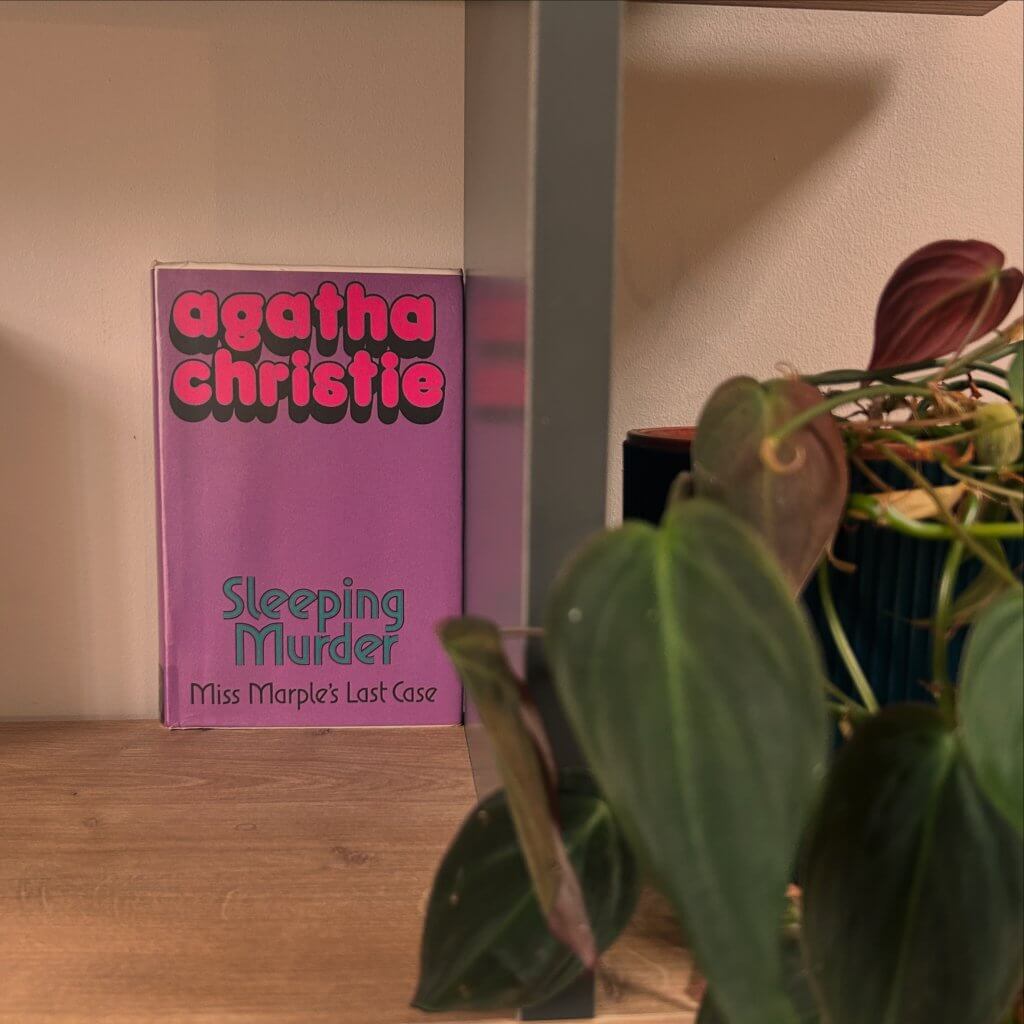
Sleeping Murder – Miss Marple (1940s/1970s)
This was Christie’s last published Marple novel, which was first written in the 1940s, then published in the 1970s, making it an interesting “time travel” novel. (The book cover pictured above is the first-edition hardback cover).
Despite its history, this novel does not have much in it that makes it seem like “the last Marple case” – she is her usual sprightly self throughout!
This is a veritable crime classic: a psychological novel with a good historic mystery that’s truly chilling. The book starts with a newly married couple settling in Devon’s sleepy (fictional) Dillmouth, buying a seaside villa called Hillside. But the wife, Gwenda, starts seeing eerie sights and wonders if there’s something oddly familiar about the house? Did she witness something terrible here or is her mind playing tricks on her?
Unearthing a murder from over 20 years ago is a task that has Marple written all over it. Town gossip and distortion are no match for her clearheaded sleuthing.
Christie supervised the publication of both Poirot’s and Marple’s last cases, but she died just before this book was published in the 1970s. She’d first written it in the 1940s and it had been locked away in the vault alongside Poirot’s last case since then. There’s a conjecture that she wrote both of these last novels during a scary time during the Blitz in London when death seemed imminent.
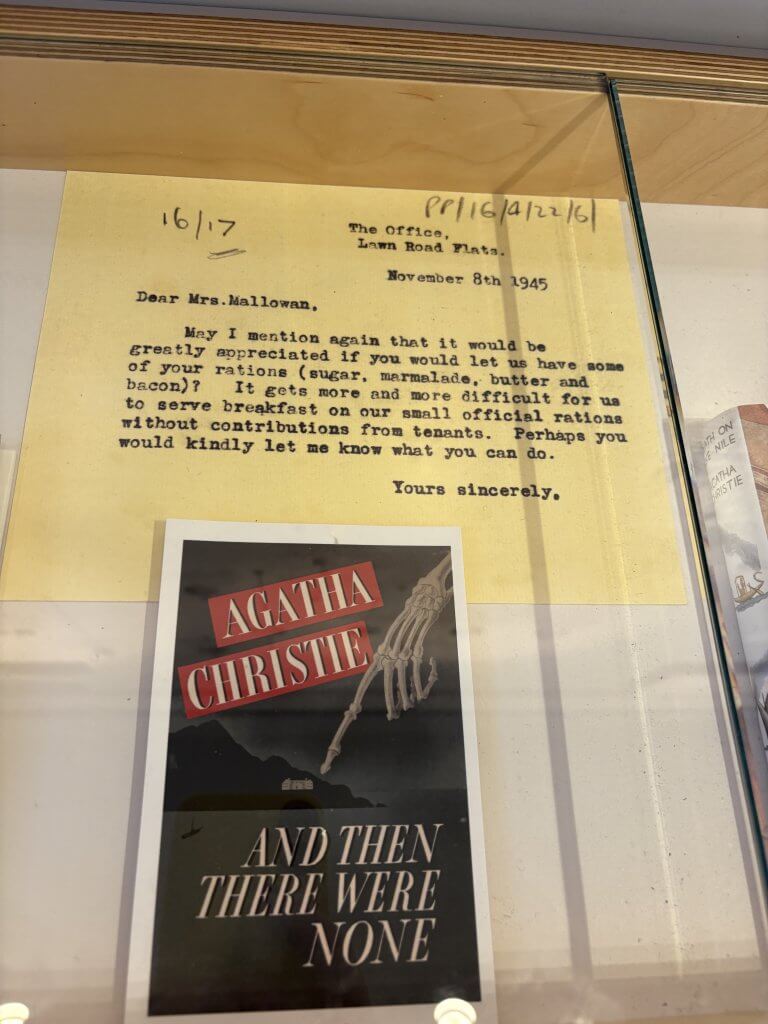
And Then There Were None – standalone (1939)
This book often tops the lists of best Christie books, and for good reason. Chilling, intelligent, and evocative, who can forget the cat and mouse game that ensues when a group of strangers are invited to a weekend house party on a remote Devon island…
When the elusive hosts fail to make an appearance, people start to talk, and it turns out that almost everybody there has blood on their hands. Without spoiling it all, there are some really
In true Christie fashion, we play around with ideas of guilt and complicity, and this is probably one of her most accomplished musings on these issues.
When people start to die, one my one, just like that ominous nursery rhyme, a thrilling psychological race against time and each other ensues.
Sparkling Cyanide – Colonel Race (1945)
Set in the glittering world of London’s nightlife, the party has suddenly stopped for a family when the beguiling Rosemary drops dead from arsenic poisoning. Was it really suicide?
This book has one of my fave Agatha Christie tropes: murder in retrospect. We are looking back at a death that happened a year ago: a young, beautiful woman seemingly committed suicide because she was depressed and alienated from her lover… or did she? Would Rosemary really drink cyanide in her cocktail?
A year later, and her husband begins to have doubts, rumours and poison letters start circulating, and her sister re-examines her sister’s state of mind leading up to her death. It’s a well written piece about how differently the victim was perceived by people, and the figure of Rosemary gets both more in focus and muddier as time goes on.
Things escalate with a second murder, and the investigation, led by Colonel Race and Scotland Yard, unravels a tangled web of relationships, secrets, and anonymous letters. It becomes a classic Christie puzzle of who loved whom, who was deceiving whom, and what really happened. In general, it’s a great meditation on perspectives.
Even though it doesn’t feature Christie’s most famous detectives, it still feels like a very accomplished and engaging novel. Originally published in 1945 and expanded from a short story, this is the final Colonel Race novel, and it holds up well as an entertaining mystery.
It also includes another trope I love: couples who seem mismatched on the surface but reveal a deeper, more complex connection as the story unfolds. Christie is particularly good at exploring the contradictions within marriages, and that adds an extra layer of depth to the mystery.
Read if you’re looking for a glamorous Christie with an edge of romance and danger.

Five Little Pigs – Hercule Poirot (1942)
Published in 1942, this Poirot novel has Poirot going back in time to piece together a murder mystery from 16 years ago. Going through testimonies and analysing everyone’s motives, this is a really satisfying and cerebral murder mystery. You get into the story and start to re-live the events of that day with Poirot.
The final denouement is incredibly ingenious and Poirot gets to display his genius understanding of human relationships in a very satisfying way.
This is one of those classic Christies where all is not as it seems.
Endless Night – standalone (1967)
This is a truly wonderful Christie: a chilling psychological novel that starts off as a meandering romance. This is one where you have to trust the process as the menacing elements of the plot build.
Michael is poor and dreams of owning a dream house made by architect Santonix. Through a series of events, he ends up meeting a young woman, Ellie, an American, at the site of Gipsy’s Acre, a place they both fall for. She’s an heiress, he is a chancer, but it’s love at first sight and they’re determined to have each other. Michael and Ellie are young married people, with the world at their feet. Or are they?
Sinister signs start to creep in, marring their happiness. Is everything in the house as it seems?
This book is also a great testament to the fact that Christie did indeed continue to write amazing books as she aged, and kept up with the times.
The Murder of Roger Ackroyd – Hercule Poirot (1926)
This is a book that is hard to review as it contains one of the most talked-about twists in crime! Published in 1926 as the third Hercule Poirot mystery, this book is a Christie classic that helped cement her reputation as an iconic crime writer.
The violent murder of Roger Ackroyd is deceptively simple, but there is a fiendish murderer out there who is a sufficient match for the intelligence of Hercule Poirot. The murder is a brutal stabbing in a study, but there is a suave intelligence to this apparently savage act. Can Hercule figure it out in time?
This is a wonderful crime novel that disrupted the genre: it’s not only worth reading as a Poirot, but also as a classic of crime that helps you understand the genre as a whole.
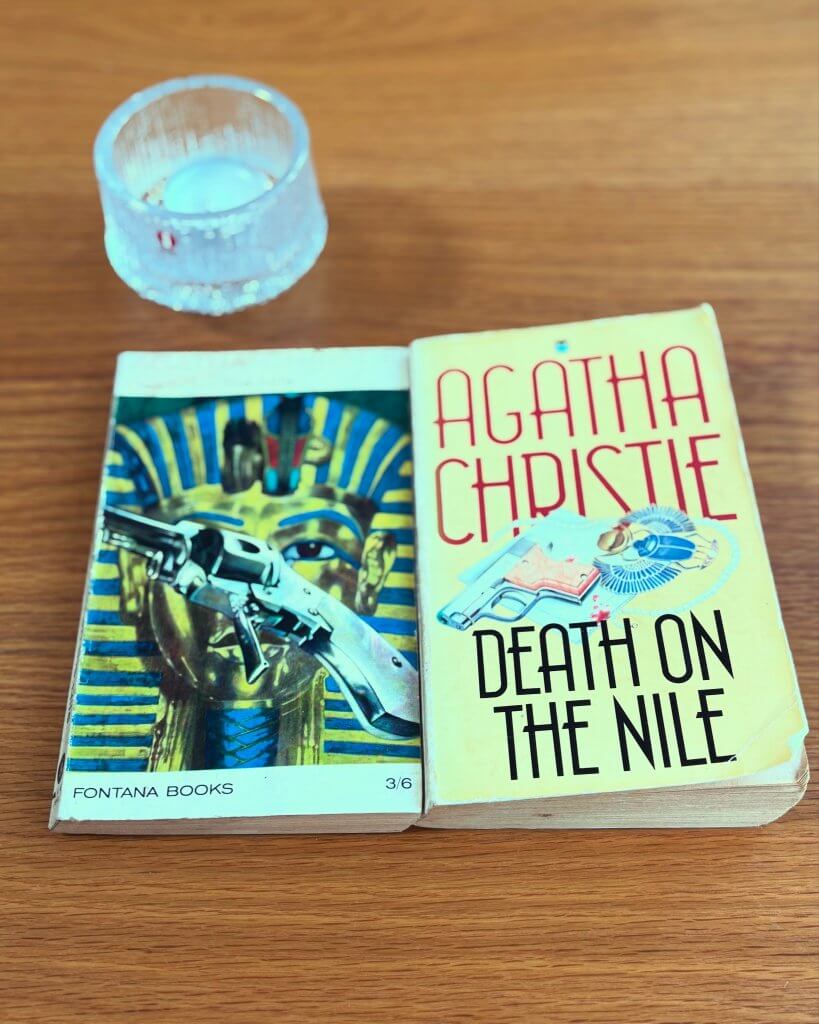
Death on the Nile – Hercule Poirot (1937)
Imagine a steamer on the Nile, floating down the river in the hot, dark night, ice cubes clinking in glasses filled with Scotch….. A captive cast of characters, a thwarted honeymoon, and lovers who want to move beyond jealous exes and their past: Death on the Nile is a masterclass in passion.
Christie has written some iconic crime books in some beautiful locations, and Death on the Nile is a great example of an iconic location adding to the crime of murder. Published in 1937, this novel has often been adapted and it is one of her most beloved works.
This is a story all about love, passion, and jealousy. Poirot is the perfect detective for untangling this dense and heady web.
Got a taste for Christie? Check out other Poirot recommendations and more Miss Marple favourites here.

Leave a Comment